Concrete retaining walls in Temecula CA - a wall that holds your slope and drains
Leaning, cracking or soggy wall holding back your yard? We build poured concrete walls with drainage behind them, so they stay put.
- Licensed and fully insured.
- Free quotes on site.
- We reply within 1 business day.
Does my yard need a concrete retaining wall?
A concrete retaining wall in Temecula is a poured wall on a concrete footing, with steel inside it. It holds back the sideways push of the soil behind it, so a slope, a raised yard or a driveway cut stays where you want it.
Most people call when a slope is creeping onto the patio, an old wall has started to lean, or they want flat ground where the yard falls away. The price moves with the wall's height and length, what sits above it, whether an old wall has to come out first, and whether you want curves or a stamped or colored face. The schedule turns on the permit and inspections, how much digging and hauling the footing takes, and the wait before the new wall can take soil behind it. You'll get your own figure in a written estimate after I've measured on site.
How do you know your retaining wall is in trouble?
The top leans outward
If the top of the wall has tipped toward you, the soil behind it is pushing harder than the wall can take, often because water has nowhere to go. A lean usually keeps growing, and the longer it goes, the more likely you're looking at a rebuild instead of a repair.
Water weeping through the face
Damp streaks, white stains or a soggy strip along the base mean water is sitting behind the wall and finding its own way out. That trapped water adds pressure every rainy season, so it's worth a look before the next one.
Cracks that keep widening
A hairline crack can be plain shrinkage, but a crack that opens wider or steps out of line usually means the footing is moving or the wall is overloaded. Patching hides it for a while, and finding out what's pushing on it costs less now than after a section gives way.
How we build a concrete retaining wall
I start by asking what sits above and around the wall, like a driveway, a slope or the corner of the house, because that matters as much as its height. Then our crew digs out for the footing, the wide base that keeps the wall from tipping or sliding, sets the forms and ties in rebar, the steel that holds the concrete together once the soil starts pushing. We pour the footing and the wall, build the drain behind it and backfill when the wall is ready for the load. Before we pour, I'll show you how water gets out from behind the wall, since water held back there is what I worry about most. The footing and the drain end up buried, and they're the first thing people want to trim when the budget's tight. I'll push back on that, because you can dress up a plain face later, but you can't add a bigger footing or a missing drain without tearing the wall out.
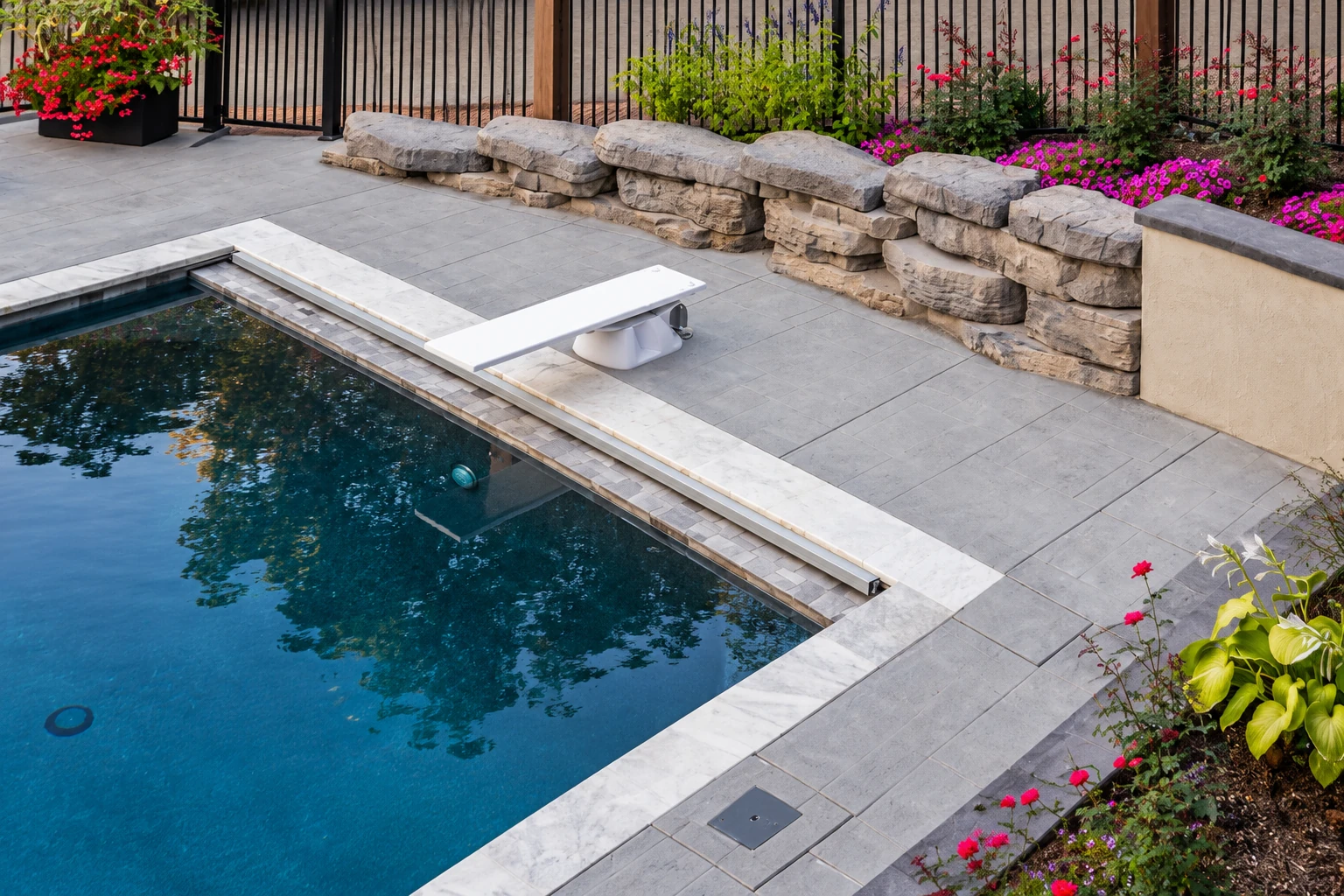
We plan the wall together with whatever goes on the flat ground beside it, so the drain outlets, the grade and the next pour line up. That might be a concrete pool deck on a yard the wall has leveled, or concrete floor installation for a room or shop set into the slope.
Poured concrete wall
This is the structural wall, the one for holding back a real slope, a driveway or anything close to the house. It costs more than a stacked wall, so I suggest it where the job needs that strength.
Block wall on a concrete footing
Concrete block set on a poured footing, where the footing holds the wall in place against tipping and sliding. It suits homeowners who like a block face, and the footing gets the same care as a poured wall.
Dry-laid stacked wall
Stacked stone or block with open joints and no mortar costs much less than poured concrete. It suits a low garden edge with little pushing on it, and if that's all you need, I'll tell you so.
Get a written estimate for your retaining wall
We'll reply within one business day and set a time for me to come out and measure. The estimate is free, done on site and written out, and there's no obligation.
(951) 466-2622- Based in
- Temecula, CA 92592
- Hours
- Mon–Sun: 6 AM–11 PM
What happens after you call about a retaining wall?
From your first call to the last walk-through, here's who you'll deal with and what happens at each step.
Call or send the form
Tell us what you've got, whether it's a leaning wall or a slope you'd like leveled. We'll set a time for me to come out.
Walk the site with me
I look at the site with you, measure, and show you on the ground where the wall, the footing and the drain would go. Then you get a written estimate, and nothing starts until you've read it and said go.
Permit, then the build
Once you say go, we handle any permit and inspections the job needs. Then our own crew does the digging, forming and pouring, not a crew we hand the job to.
Final walk-through together
When it's done, I go over the finished wall with you, including where the drain outlets come out. Those outlets need to stay clear and working over the years, so it helps to know where they are.
Why Temecula homeowners call Cornerstone Temecula Concrete Works for retaining walls
I measure and estimate every wall
I come out myself to look at your wall, measure it and give you the estimate, and our own crew does the forming, pouring and finishing. You talk with the person who answers for the work, not a salesperson.
Pouring in Temecula since 2013
I opened this business in Temecula in 2013, after years of patching walks, steps and slabs someone else had poured. That's 13 years of seeing what fails and building so it doesn't happen on your wall.
Licensed and fully insured in California
California licenses concrete contractors to form, pour, place and finish concrete, which covers every stage of a poured wall. We're licensed and fully insured for that work.
The parts of a wall that matter most end up buried, so it's worth seeing them planned on your own ground. Ask for a site visit or call (951) 466-2622.
Retaining walls, grading and permits in Temecula
In Temecula, the city's Department of Public Works issues grading permits, and it requires one before most construction or grading work within private development in the city. The city counts, in general, any digging out or filling as grading, and a retaining wall is both, since we dig for the footing and fill in behind the wall. What I can't tell you from a web page is whether your particular wall needs a permit, so we don't guess. We work out which city or county office it goes through, pull the permit, set up the inspections and tell you what falls on your side as the owner.
Around Temecula we build a lot of walls on hillside lots and tiered yards, where a driveway or patio sits right above the wall and adds to the load. We plan for that from the first visit, and we see the same cut-into-the-slope yards on jobs in Murrieta and Menifee.
Questions about concrete retaining walls in Temecula
How much does a concrete retaining wall cost in Temecula?
Concrete retaining wall installation in Riverside, California usually costs about $16 to $46 per square foot of wall, covering the digging, site prep, forms, pour, basic finishing and cleanup. Removing an old wall, a stamped or multi-colored face, curves, extra height and difficult soil push it toward the top. For your Temecula wall, I'll measure on site and give you a written figure.
Why do retaining walls fail?
Most retaining walls fail because water or wet soil builds up behind them and presses on the wall. Every wall should let that water drain freely down and away, so whoever builds yours, ask them to show you how it will drain.
Which city offices handle permits for a retaining wall in Temecula?
Public Works issues grading permits, and the city's Building Department handles plan check, permits and inspections for building permits. The city also lists a handout on retaining walls and block walls built on top of them among its forms and handouts. Which office your wall goes through depends on the job, and we sort that out before we start.
Can I add a driveway near my retaining wall later?
You can, but a driveway near the wall, new backfill or water left to build up behind it can undo what the wall was designed for, even when the concrete itself is strong. If you think you'll want a driveway or a structure up there someday, tell me before we build, so the wall is planned for it.
How long does a new retaining wall need before soil goes back behind it?
Soil goes back behind the wall only once the wall has gained enough strength and any bracing it needs is in place, not right after the pour. Heavy compaction machines right behind a young wall can overload it, so we pack the backfill in controlled layers.
How do I know what size retaining wall I need?
Height alone won't tell you, because groundwater, the weight of cars or a building nearby, a slope above and earthquake shaking can all add to what the wall has to hold back. That's why the footing, the steel and the drain should come from the wall's design or the building code.
Related concrete work around a retaining wall
If the wall cuts into a slope to make room for a shop, garage or lower room, you'll need a level floor slab poured on that new ground.
Once a wall holds back the slope, the flat yard it leaves is often where a pool goes, and the deck around it needs a solid, draining base.
Service areas for concrete retaining walls
Cornerstone Temecula Concrete Works is based in Temecula, CA, and builds retaining walls across the 12 cities listed below, including Lake Elsinore and Wildomar. These are the cities with their own page, not the only places we work, so if yours isn't here, call and ask.
Temecula, CA
Book a site visit for your retaining wall
Jot down the wall's rough length and height and what sits near it, like a driveway or the house, and we can talk it through on the first call.